You don't have a productivity problem. You have an instrumentation problem.
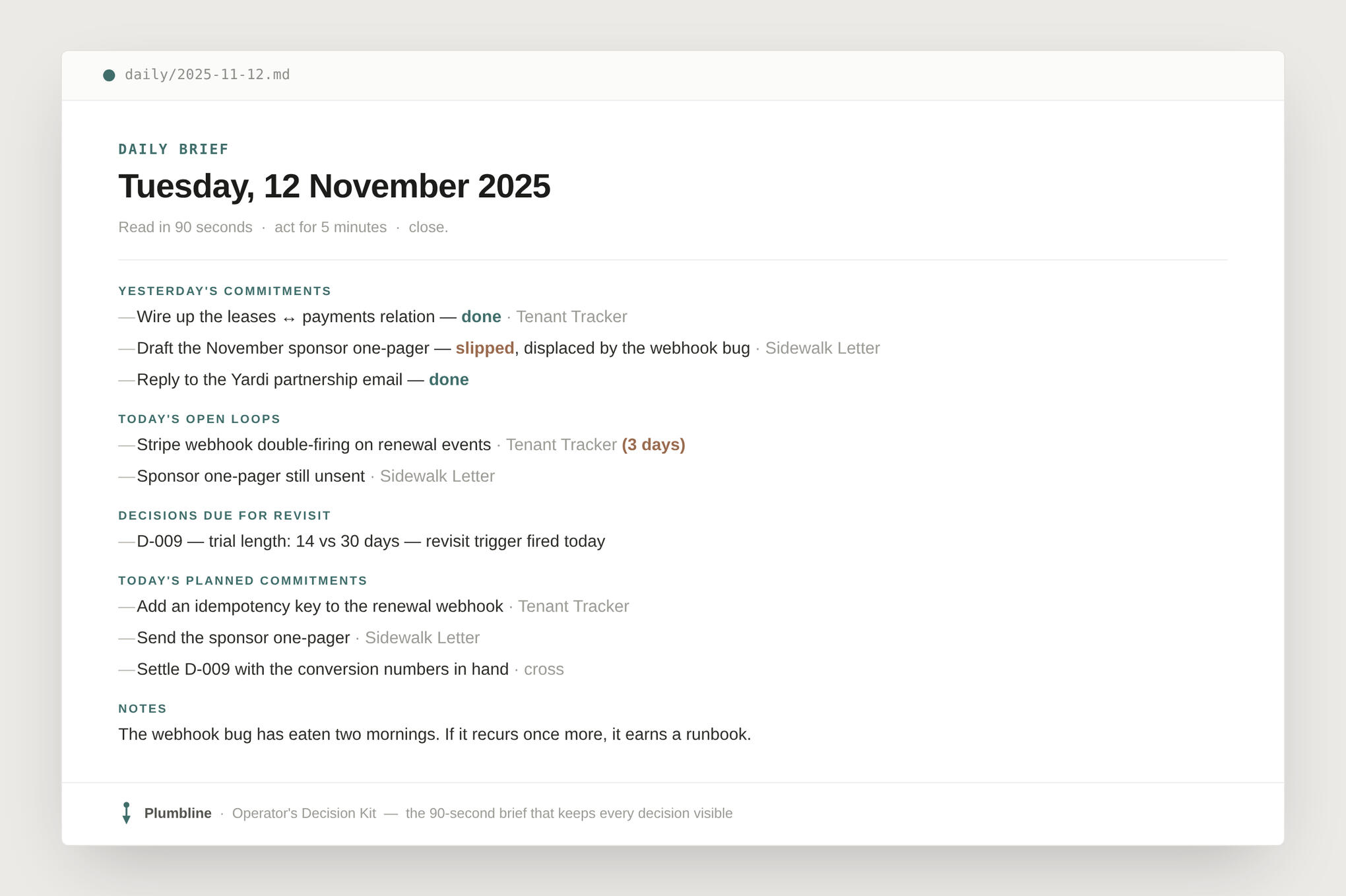
A discipline for tracking decisions across multiple projects — so you stop re-deciding what you already decided.Most operators write 1–3 entries per week and get a 90-second daily brief that surfaces every decision due for revisit. After 30 days: you stop losing the operating reasons behind your own commitments.$39 · plain markdown + JSON · no install · 14-day refund
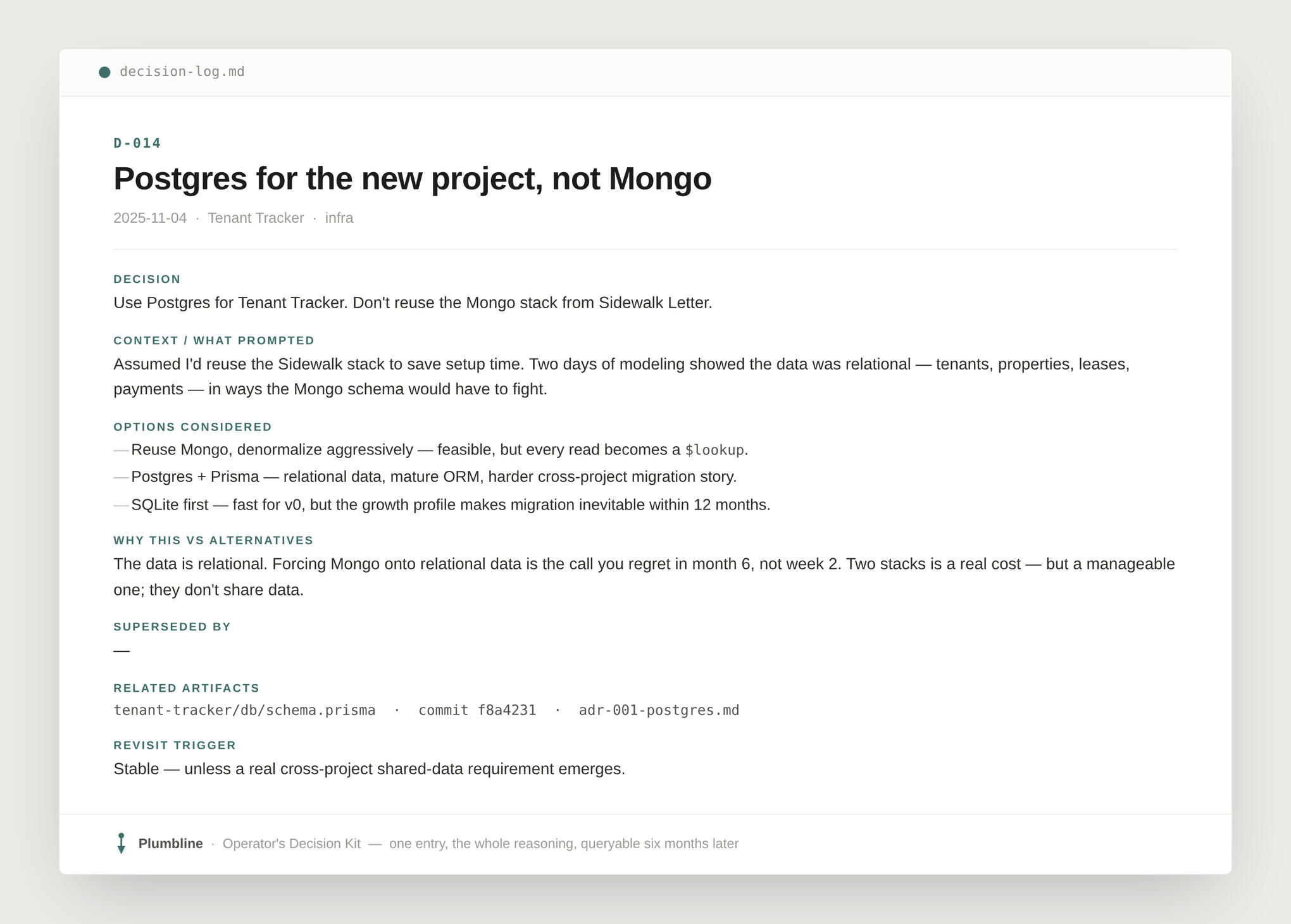
The thing this fixesSix months from now, a question arrives: "Wait, why did I pick Stripe over LemonSqueezy?" You remember roughly when, vaguely why, and absolutely the thing you wanted to avoid. The actual reasoning — the lever that tipped the call — is gone. So you re-decide. Sometimes the same way. Sometimes not, because the operating reason is gone.This is decision archaeology, and it gets worse with project count. One project, fine. Two projects, three tools, two laptops, a phone — the surface area exceeds your retrieval bandwidth.Notes don't fix it (notes are content, not commitments). TODOs don't fix it (TODOs are forward-looking; the question is backward-looking). Project docs don't fix it (project docs explain what; the question is why).What's in the kitA 10-section operating manual (~25 minutes of reading). The discipline behind the kit: when to log, what counts as a decision vs a preference, the eight-field schema explained field-by-field, six common failure modes named with their fixes.Three templates — decision log, daily brief, runbook — and a frontmatter conventions doc that ties them together. Each template ships with a JSON schema for validation.Five worked examples showing the schema in real shapes: a pricing tier collapse, a stack pick, a client decline, a strategic wind-down, a channel pivot.Who this is forSolo founders or operators running 2 or more active projects (consulting + product, two products, one product + side ventures). 6–18 months of accumulated work. You've used Obsidian / Notion / Roam. You've said out loud or in a DM, "where did I write that down."Who this isn't forBig-company employees with company-issued PM tools. Hobbyists with one project. Teams of five or more (the discipline depends on a small number of writers; section 10 of the manual names the migration path to ADRs + a real ALM tool). Anyone who wants a productivity system or a "second brain" framework. This isn't that.Stacks supportedObsidian (primary), Notion, plain markdown + git, Roam / Logseq. The schema travels; the rendering doesn't matter.
About this kitThis kit fell out of running five ventures in parallel for the past 18 months — a decentralized finance protocol, a music apparel brand, agentic systems for an international payroll company, a fully autonomous AI research podcast, and this. AI agents do most of the operational rails across all five, which is what makes the cadence possible. Decision-tracking was the discipline that broke first under the multi-venture load — and the discipline that, once fixed, made everything else hold. The kit is that discipline, written down.What you actually buyA zip — one START-HERE document, one operating manual, three templates with JSON schemas, one frontmatter-conventions doc, five worked examples, a CHANGELOG, and a license. Plain markdown and JSON. Nothing to install, nothing to maintain, no service to depend on.If the felt pain in section 1 of the manual doesn't match yours, refund within 14 days. The kit is small on purpose — the fit decision should be fast.I built this for one specific job: keeping decisions queryable across multiple projects. If that's the job you're hiring for, the kit will earn its $39 in one decision-archaeology save. If you're hiring for "make me more productive," this isn't the right purchase.
14-day refund window — reply to your purchase receipt and I'll process it.Questions: [email protected]Free primers from Plumbline:
The Frontmatter Discipline → frontmatter-discipline.carrd.co
The Daily Brief Kit → daily-brief-kit.carrd.co